
Contact us
Send Us Your Case Details
We’ll respond and let you know the best way to proceed with your case.

Driving in Montana often means sharing the road with tractors, combines, balers, and other types of farm equipment. These vehicles play an important role in the state’s agricultural economy, but they also create unique risks for everyday drivers.
Understanding how Montana law treats slow-moving vehicles can help you avoid accidents and know what your rights are if something goes wrong.
In Montana, a slow-moving vehicle is generally defined as any vehicle that travels at speeds of 25 miles per hour or less on public roads.
This includes many types of agricultural equipment, along with other vehicles that are not designed for highway speeds. Tractors are the most common example, but the category can also include:
These vehicles are not built for speed, and they often take up more space on the roadway. Because of this, Montana law requires them to be clearly marked so other drivers can recognize them from a distance.
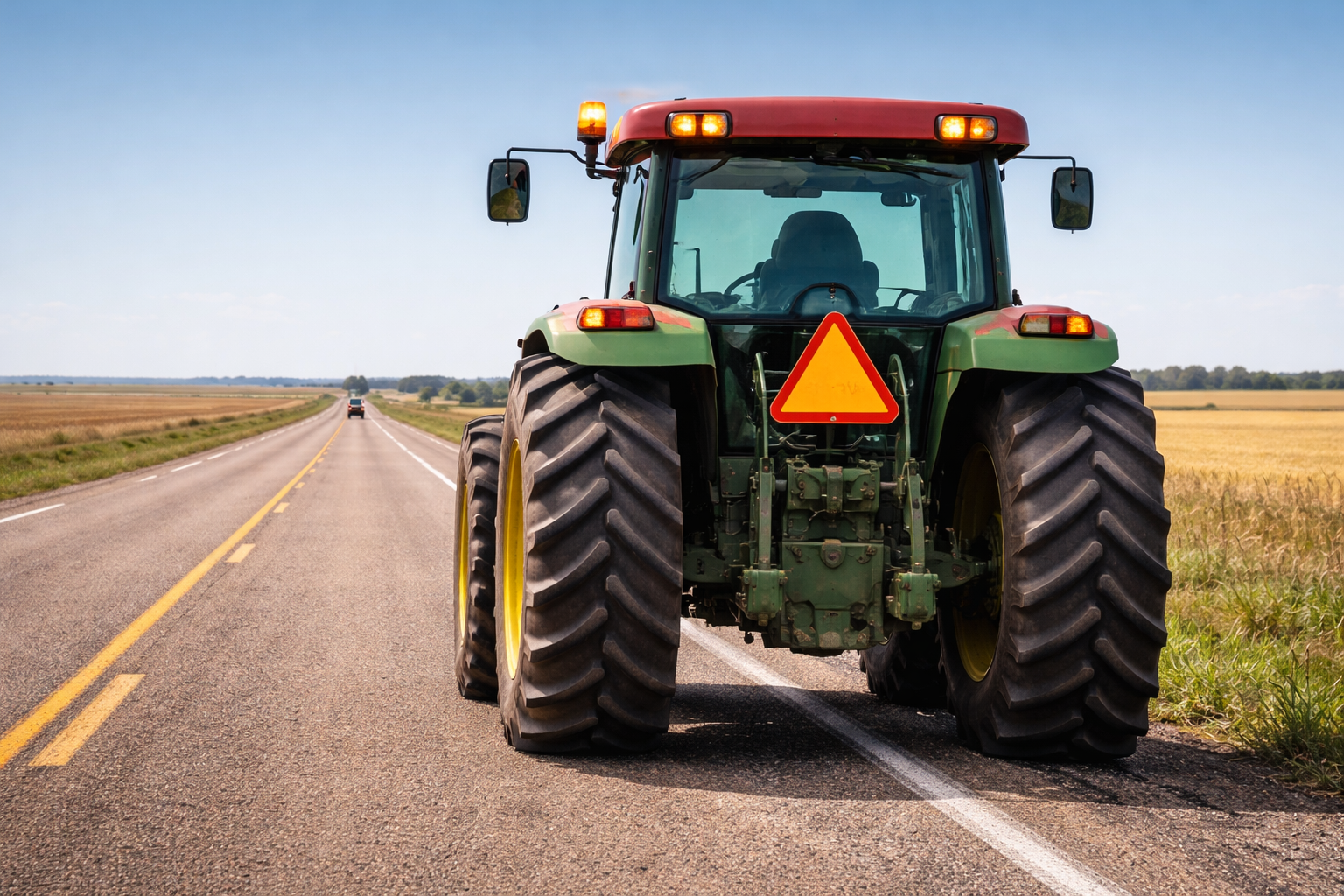
The most recognizable feature is the orange triangular slow-moving vehicle emblem. When you see this sign, it’s a signal to reduce speed and approach with caution.
Yes, tractors and other farm equipment can be legally driven on public roads and highways in Montana. This is necessary for farmers moving equipment between fields, farms, and storage areas.
That said, there are expectations that come with using public roadways. Tractor operators are required to follow traffic laws just like any other driver. This includes yielding when appropriate, using signals when turning, and operating in a way that does not create unnecessary danger.
At the same time, drivers of passenger vehicles also have a responsibility to adjust. Tractors move much slower than normal traffic, and approaching one too quickly can lead to serious accidents.
Many crashes happen when a driver does not realize how slow the equipment is moving or tries to pass without enough visibility. Staying alert and giving farm equipment extra space is one of the best ways to avoid a collision.
Visibility is one of the biggest safety concerns with slow-moving vehicles, especially in low-light conditions.
Montana law requires certain farm equipment to use lighting and reflective markings so they can be seen by other drivers. While the exact requirements can depend on the type of equipment and time of day, common safety features include headlights, taillights, and reflective materials.
The orange slow-moving vehicle emblem also plays a major role. It is designed to be highly visible during both daylight and nighttime conditions when properly maintained.
Problems can arise when equipment is missing these features or when they are not working properly. For example, a tractor traveling at dusk without adequate lighting can be difficult to see until it’s too late to react.
If a crash happens and the equipment was not properly marked or visible, that can become an important factor when determining fault.
Accidents involving farm equipment are often tied to a few predictable situations. One of the most common is a driver approaching a slow-moving vehicle at highway speed and not realizing how quickly they are closing the distance. These accidents are rarely simple. They often involve a mix of driver behavior, visibility issues, and roadway conditions.
Passing is another major factor. On narrow Montana roads, drivers may attempt to pass farm equipment without a clear view of oncoming traffic. This can lead to head-on collisions or side-impact crashes.
Turning movements also create risk. Farm equipment may make wide or unexpected turns into fields, driveways, or side roads. If a driver is following too closely or trying to pass at that moment, a collision can occur.
If you’re involved in a crash with a tractor or other slow-moving vehicle, what you do next can affect both your recovery and your ability to pursue a claim.
Start by making sure everyone is safe and contacting emergency services. Even if injuries seem minor, getting medical care is important. Some symptoms take time to appear, and having a medical record tied to the accident can help later on.
It’s also important to document the scene as thoroughly as possible. Photos of the equipment, lighting, road conditions, and any visible markings can help show how the crash happened. In these cases, details like whether the vehicle had proper reflectors or was visible from a distance can matter.
Once you’ve addressed immediate concerns, it’s a good idea to understand your legal options. The team at Conner, Marr & Pinski can review what happened and help you determine the next steps based on your situation.
Liability in slow-moving vehicle accidents often comes down to the actions of both parties leading up to the crash.
A farm equipment operator may be responsible if the vehicle was not properly marked, lacked required lighting, or entered the roadway without yielding. At the same time, drivers are expected to recognize slow-moving vehicle signs and adjust their speed and distance. Following too closely or attempting to pass without a clear view can also lead to shared fault.
Montana follows a comparative fault system, which means more than one party can be responsible. If you are found partially at fault, it can reduce the amount you are able to recover.
Because these cases often involve questions about visibility, timing, and road positioning, the details matter. A careful review of the evidence is usually needed to determine what really happened.
If you’re dealing with questions about fault after a crash, contact Conner, Marr & Pinski. Our team works directly with clients across Montana and can help you understand where your case stands.
Accidents involving slow-moving vehicles are different from typical car crashes. They often involve unique laws, equipment requirements, and rural road conditions. At Conner, Marr & Pinski, we’ve recovered millions for accident victims across Montana. We understand how these accidents happen and what it takes to build a strong case.
When you work with our firm, you work directly with the attorney handling your case. You stay informed, and your case gets personal attention from start to finish. If you’ve been injured in a crash involving a tractor or other slow-moving vehicle, contact Conner, Marr & Pinski to talk through your situation and learn what your next steps can look like.